A smarter consumer, a crowded shelf: the race for Innovation
It is eleven at night and a 22-year-old asks her favourite AI tool: “It is my final exams week coming up, what supplements can I take to cope with the stress and boost my energy?” Thirty seconds later she has a plausible answer: three ingredients she had never heard of and a working vocabulary of cortisol, adaptogens and bioavailability. By midnight she has bought two products. She may still check the label, ask a pharmacist or look for an expert’s endorsement before she commits; and often she will, but she no longer starts there. She arrives at the category already fluent, already sceptical and already certain about how she wants the outcome to feel.
Multiply her by a generation and you have the single most important shift in consumer health. The consumer now shows up educated, impatient and emotionally specific; and evolving faster than most brands can reformulate. Keeping pace is what innovation in this category now means and it is worth spelling out where the leaders are innovating and why it is working.
The prize justifies the sprint. The UK dietary supplements market was worth around $3.45 billion in 2025 and, on one industry estimate, is forecast to more than double to approximately $9.0 billion by 20351. Usage skews to the young, with 83 percent of under-35s taking a Vitamins, Minerals and Supplements (VMS) product against 65 percent of over-55s2, and challengers are already taking share from the mainstream brands. The incumbents are not struggling because they stopped making good tablets, but because winning stopped being about the ingredient alone. Competition now runs across four fronts at once: how the product is positioned, what goes into it, how it is delivered and how it reaches the consumer.
Narrative innovation: when the story becomes the product
The first front, which is often the most overlooked yet valuable, is how the benefit is communicated. Today, those claims are table stakes. Everyone makes them; the only difference is the font and colour. Claims have become the price of being on the shelf rather than a reason to be chosen. The innovation is in the storytelling, moving the pitch from what a product does to how it helps you live. So the winning vocabulary has changed: calm, glow, mental clarity and resilience rise fastest; and the sharpest brands layer physical and emotional benefits together, gut health with visible vitality, hormonal balance with beauty3. One example is Nutrition Geeks, which uses an ingredient-plus-benefit naming convention that clearly communicates the product’s purpose such as Ashwagandha Calm, Lion’s Mane Focus and Iron + Energy.
The caveat, and the reason narrative is a front rather than the whole game, is that a story only holds if the other three deliver on it. Trust is earned through scientific proof and sustained through how a product makes people feel and the brands that endure get that sequence right.
What’s next: One of the sharpest new narratives is healthspan: the years lived in good health rather than simply alive, a more precise and resonant frame than the older “longevity” pitch. The pull is measurable, with Euromonitor finding a healthspan claim on 50 percent of new supplement SKUs launched since mid-20244 and IM8, David Beckham’s cellular-health subscription, reaching over $200 million in annualised revenue within 19 months5. Expect cellular and “hallmarks of ageing” language to move mainstream and regulators to tighten around any healthspan promise the science cannot underwrite.
Ingredients: from familiar staples to a science-led frontier
Sustainability remains a defining priority in the beauty industry, moving beyond marketing into core brand strategy and product development as consumers scrutinise packaging, sourcing practices and ingredient transparency, pushing brands to adopt more circular, low-impact business models. It is fast becoming a baseline expectation, particularly among younger, digitally native consumers who are holding brands accountable for their environmental and social impact.
Vitamins B, C and D still anchor the category and still carry consumer trust, appearing on far more launches than anything newer3. But trust alone no longer differentiates. The real innovation is happening at the edges, where a science-backed active ingredient meets a specific, self-diagnosed consumer need. Five examples show the pattern and each is now visible on UK shelves rather than confined to a biohacker forum:
-
Lutein, for the screen-fatigued. As younger consumers rack up screen hours, eye strain has become an everyday complaint rather than an over-60s concern: 62 percent of working adults in the UK and Ireland report symptoms of digital eye strain. That has pulled lutein out of the seniors’ aisle into products aimed at twenty-somethings6.
-
Beta-glucan, for the gut-immune consumer. The idea of the gut as a second brain has gone mainstream and with roughly 70 percent of the body’s immune cells residing in the gut, beta-glucan rides a gut-immune link consumers now accept7.
-
Ashwagandha, for the always-on and anxious. Stress, poor sleep and burnout define the always-on generation: 91 percent of UK adults experienced high or extreme stress in the past year, with 18 to 24-year-olds hardest hit8.
-
Creatine, well beyond the gym. Once shorthand for gym bulk, creatine has broken out into brain, bone and women’s health: creatine gummy launches in Europe rose 48 percent in a single year. UK women’s brand Unfabled launched a Creatine Superblend and sports brand VOW Nutrition added creatine chews, both riding the convenience wave9.
-
Magnesium, now form-specific. The clearest sign of a more educated consumer is that she no longer buys magnesium, she asks which form: glycinate for sleep, citrate for digestion.
What’s next: The differentiator shifts from the hero ingredient to the proven combination, the “hormone-brain” and “gut-immune” stacks, GLP-1 companion formulas that protect muscle during weight loss and postbiotics. As actives like NMN (nicotinamide mononucleotide) mature and supply chains scale, the edge migrates from novelty to dose, purity and evidence.
Format: the experience of the feeling
If the claim is the emotion, the format is the experience of it and pill fatigue has turned that experience into a competitive weapon. Chews and gummies have climbed from 8 to 11 percent of new European launches in a few years10, with oral melts, layered beauty gummies and candy-textured capsules now shelf staples and clear room for patches, gum and dissolvable strips11,12. A format someone enjoys is what turns a one-off purchase into a daily ritual and the ritual underwrites lifetime value. The most defensible stories pair that experience with delivery science the consumer can feel: BetterYou’s oral sprays engineered to sidestep digestive absorption13, Zooki’s liposomal liquid sachets claiming up to four times the absorption of their standard supplements14. Another front in the fight is manufacturing, from Nourished and Rem3dy Health 3D-printing personalised gummies15 to ingredient houses like TSI and Sirio selling proprietary processing to the brands that cannot build it16,17.
What’s next: Format becomes an explicit signal of function and the next wave is oral pouches, patches, dissolvable films and gum for indirect intake, plus personalised, dual-layer and timed-release systems. Novelty alone will fade fast; the winners will be those whose format is inseparable from a proven delivery mechanism.
Distribution: meeting the consumer where the ritual happens
The least-copied innovation of all is not on the label, it is the route to the consumer. The pill aisle assumes a planned purchase; the modern wellness consumer buys in the flow of her day. Zooki is a good example, its single-serve sachets sold not only through Holland & Barrett, Boots and Selfridges but in smoothie bars, boutique gyms, spas and co-working spaces18. A gym selling a liposomal shot at the counter is not a new till point, it is distribution as endorsement. The strongest challengers run a hybrid of direct-to-consumer, subscription and selective retail, and collaboration is becoming a route in itself: in April 2026 Free Soul and matcha brand PerfectTed launched a co-branded latte range across their own sites, Amazon, TikTok Shop, Holland & Barrett, with Tesco following in June19.
What’s next: Expect the venue itself to become a differentiator, from gym and clinic tie-ups to GLP-1 weight-loss services layering in muscle-protecting supplements. The most interesting question is which channel-and-product combinations create the most consumer value, and who ends up owning the relationship and the data as AI-led personalisation turns it into a tailored subscription.
The money is following the innovation
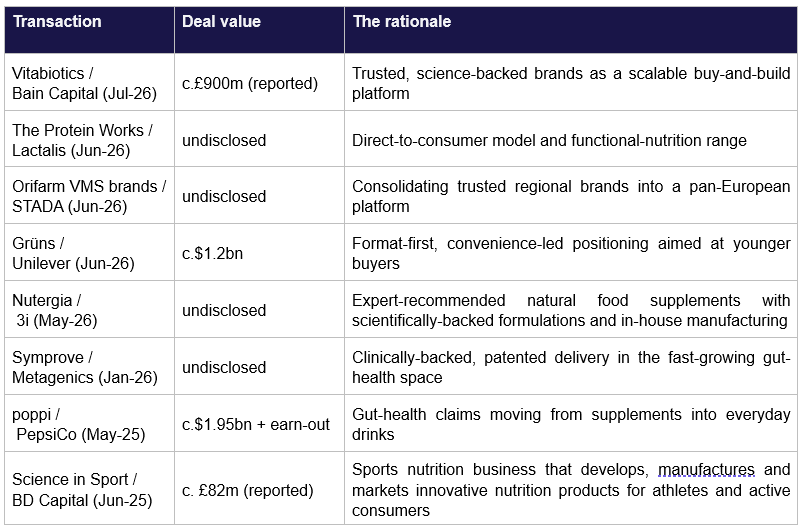
The clearest sign that this is real, and not a trade-press trend, is where the capital is going, from both strategic and financial buyers. Large strategics are acquiring the innovation they could not build fast enough while quietly pruning the commodity tablet lines that built them. Unilever’s acquisition of gummy brand Grüns20 and Hindustan Unilever taking full ownership of India’s OZiva21 both put a premium on format-led, emotionally-fluent positioning. Private equity has followed with conviction of its own, Cinven backing Vitamin Well22 and CVC backing Sunday Natural23 among the clearest examples. Nestlé, by contrast, has decided to divest parts of its own supplements portfolio24, a reminder that scale without differentiation is now a liability, not a lead.
The 2025–26 deal flow makes the pattern concrete, spanning trade buyers, private equity and big-food, across supplements, gut health, protein and functional drinks :
What this means for investors
Four things follow for investors. Innovation is now the whole competition, running on four fronts at once, narrative, ingredients, format and distribution; and premium multiples go to the brands moving on several aspects together.
The defensible asset sits below the label, in the delivery science, manufacturing, distribution relationships and clinical evidence a competitor cannot copy in a season. Format and distribution are the quiet economic engine, converting a purchase into a subscription and a subscription into lifetime value, which is why retention and LTV to CAC, not follower counts, unlock capital. And the growth is durable: wellness spend concentrated in exactly the innovative, differentiated niches this piece describes, not the tablet aisle that used to define the category.